Insights from ALBATROSS at the International Conference on Migrations and Climate in Africa: Emerging Dynamics and Future Challenges
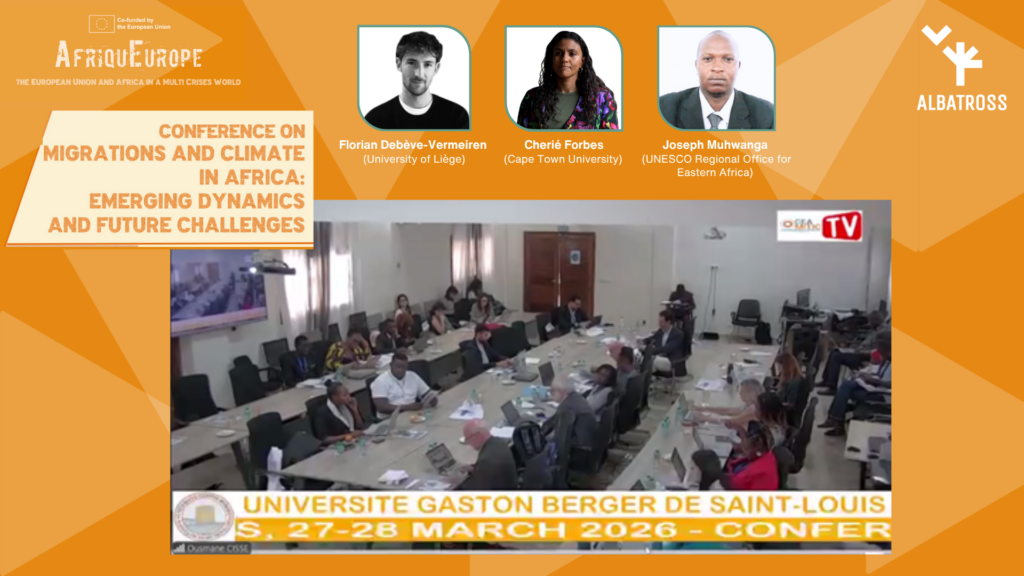
On 28 March 2026, the ALBATROSS partners Florian Debève-Vermeiren (University of Liège), Cherié Forbes(Cape Town University) and Joseph Muhwanga (UNESCO Regional Office for Eastern Africa) participated at the International Conference on Migrations and Climate in Africa: Emerging Dynamics and Future Challenges, held in St. Louis, Senegal.
The conference was organised by the AfriquEurope network, and covered several aspects of the topics under discussion, being the session in which the ALBATROSS partners participated about Climate Governance, Legal Issues, and EU-Afric Cooperation. It was moderated by the associate professor Panagiota Manoli, from the University of the Peloponnese Greece).
In their intervention, they shared with the audience insights from ALBATROSS, focusing on how adaptation choices, especially nature-based solutions (NBS), can influence mobility patterns and local livelihoods, and how policy frameworks can better anticipate these interactions in SSA.
They explained how climate change is reshaping mobility dynamics across Sub-Saharan Africa. However, these movements are neither linear nor uniform. Instead, they depend on factors such as livelihoods, exposure to hazards, urbanisation trajectories and the availability of credible adaptation options. They presented three complementary pieces of evidence derived from the project’s research:
1. An in-depth analysis of migration trends and urbanisation patterns under current and projected climate conditions helps frame where and for whom climate stress is likely to translate into mobility pressures and urban change.
2. A multi-level policy mapping and coherence assessment, examining how environmental, adaptation, and development policies create enabling, or constraining, conditions for integrated responses.
3. Evidence on mechanisms linking NBS, livelihoods, and mobility, drawing from systematic synthesis and learning generated through stakeholder-engaged casework in SSA contexts.
Nature-based solutions can influence mobility by stabilising or diversifying livelihoods, altering local opportunities and access to land and resources, as well as influencing the attractiveness of urban and peri-urban areas as destinations. These pathways interact with policy design, which can exacerbate vulnerability and displacement risks, or conversely, manage climate-related mobility properly while strengthening resilience.
Share on Facebook Share on Twitter Share on Pinterest