ALBATROSS develops methodologies to project demographic and urbanisation trends in Sub-Saharan African cities
The ALBATROSS partners of the University of Liege (Belgium) have developed two different simulation models to simulate and anticipate both demographic and urbanisation trends for the coming decades and their interplay with climate change.
Sub-Saharan Africa faces major urbanisation challenges as a result of the fast urban growth it is experiencing, the fastest in the world nowadays. This urbanisation, often spontaneous and informal, places considerable pressure on infrastructure and limits the capacity of public actors to anticipate future challenges, which renders African cities particularly vulnerable to floods, droughts, and other climate-related hazards.
With the aim of serving as a tool to shape policy recommendations tailored to local, national, and regional governance structures, the ALBATROSS team has developed two models, which are complementary to each other, to ensure demographic trends and urbanisation dynamics are effectively integrated into climate adaptation strategies at both local and national levels.
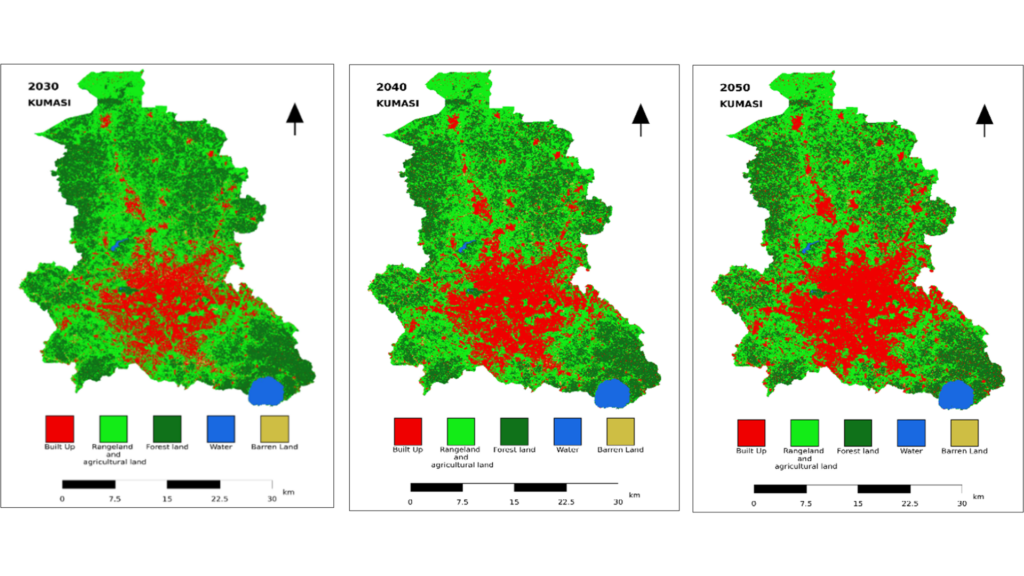
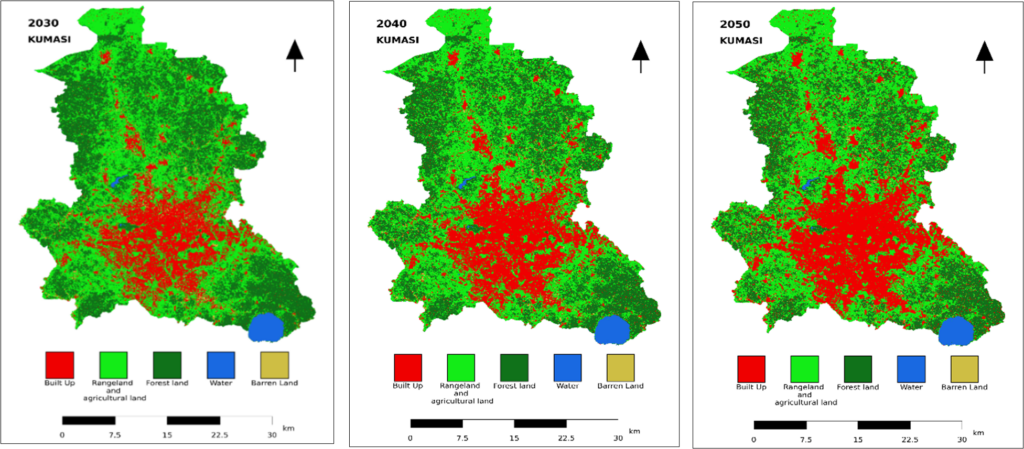
The urbanisation model (cellular automata-based simulation) was developed for two ALBATROSS urban hubs: Kumasi (Ghana) and Dar es Salaam (Tanzania). This modelling approach facilitates an understanding of spatial dynamics and helps anticipate future challenges by identifying high-risk areas for urban development. Authorities can then implement proactive measures, including sustainable solutions such as nature-based solutions.
The model’s findings indicate that, despite the persistence of observed urban trajectories (Figure 1), greenbelts provide a practical and scalable tool for mitigating uncontrolled peripheral expansion and preserving strategically designated spaces. They enable the modulation of future urbanisation patterns at the regional scale, particularly in contexts where demographic transition coincides with weak or underdeveloped planning frameworks.
The effectiveness of greenbelts remains conditional and warrants further research. For instance, a deeper understanding of the drivers of urban sprawl, particularly in light of the emergence of a motorised middle class commuting to central areas for work, might demonstrate that urban sprawl in sub-Saharan Africa is not solely a poverty-driven process (Andreasen et al., 2017). Another factor that warrants further analysis is the challenge of institutional fragmentation, which is exacerbated by the polycentricity of major African cities (Ankrah et al., 2026; Kanai & Schindler, 2019). This fragmentation could constitute a significant barrier to the implementation of nature-based solutions in African metropolitan areas, which, despite their great diversity, are characterised by a complex interweaving of numerous actors (Schlimmer, 2022).
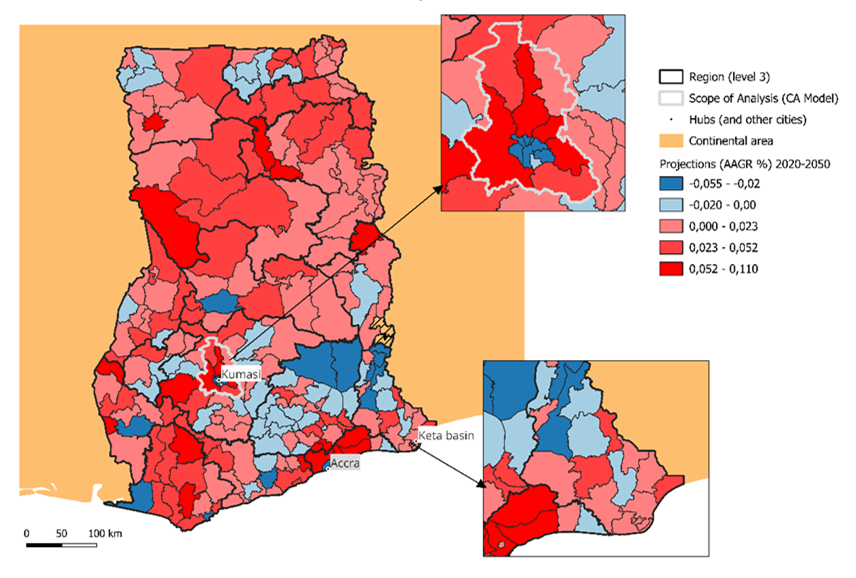
This urban modelling was complemented by the other model, which offers demographic projections at the district level for all five countries involved in the project. These projections are generated under three UN fertility scenarios (low, middle, and high) and are presented at the national scale (Figure 2). This model allows for a reassessment of urban evolution in each hub through the lens of demographic and socio-economic dynamics operating at broader scales. As a projection model, it helps anticipate macro-trends and predict medium-term demographic growth. It has thus made it possible to identify an urban pattern characterised by relative demographic decline in the central districts of metropolitan areas, coupled with sustained growth in peripheral districts, sometimes located far from the core.
The models developed are the result of ten months of research and are now capable of projecting urbanisation and demographic growth up to the year 2050. Their development required extensive data collection, including satellite and demographic data, as well as the creation of specific protocols in a context marked by a scarcity of public data. The authors acknowledge that limited data availability introduced certain limitations. The researchers, however, stated that these models have valuable potential, particularly forestimating population and urbanisation at fine scales in contexts of high demographic growth. This makes them applicable to public policy decision-making, especially in cases ofinadequate urban planning framework
Finally, these findings enable us to reassess climate-related migration in the light of the structural trends of demographic and urban transition. Urban growth is largely driven by current but powerful demographic dynamics. Climate change, therefore, appears to be an additional factor that is likely to reshape, intensify and complicate these ongoing growth dynamics.
Share on Facebook Share on Twitter Share on Pinterest