
- This event has passed.
Become a Climate Resilience Trainer-webinar-2
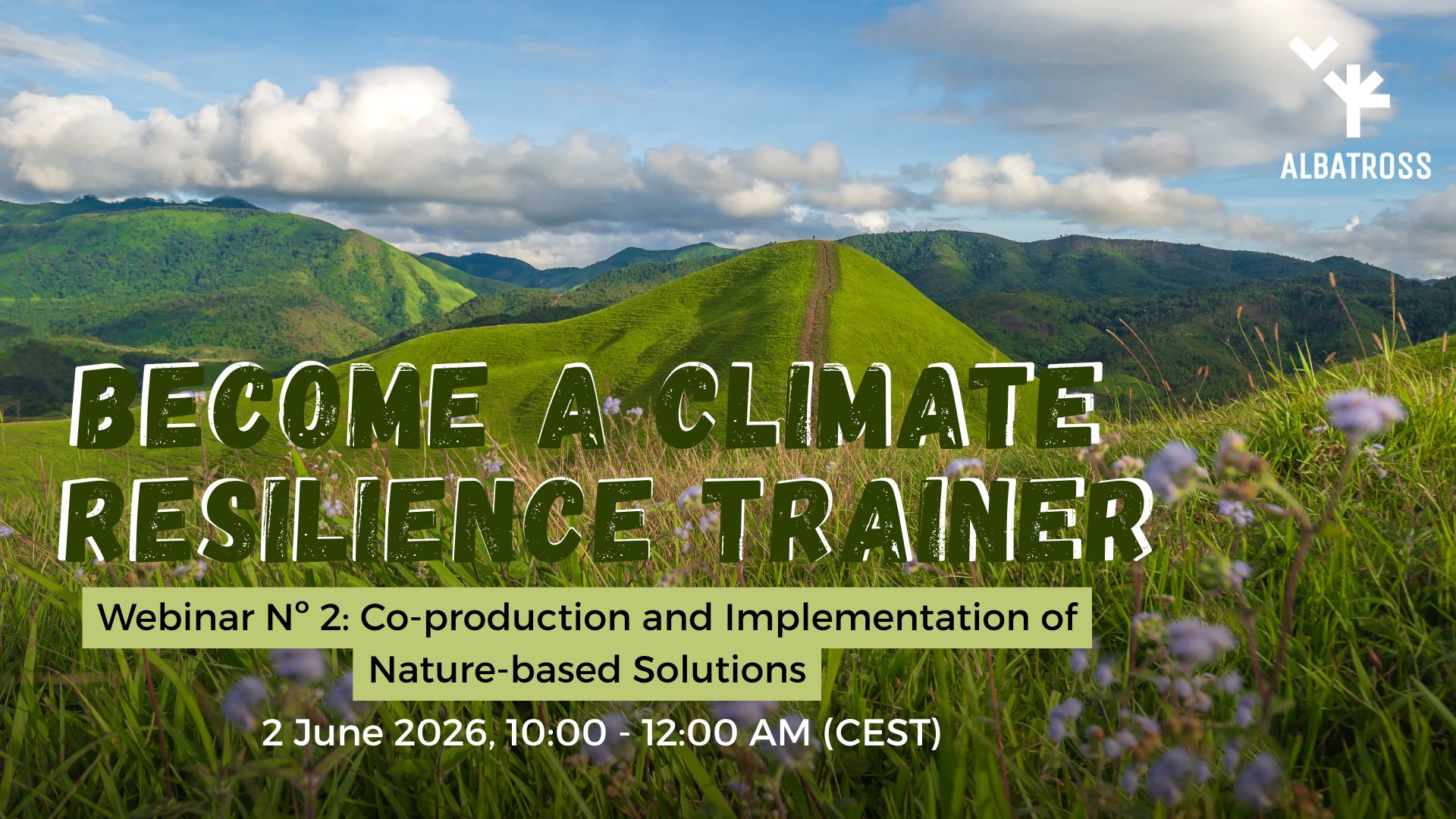
Webinar No 2: Co-production and Implementation of Nature-based Solutions
The ALBATROSS project is launching a Training of Trainers initiative across five African countries to help vulnerable communities move beyond traditional coping mechanisms that are no longer sufficient against escalating climate shocks. By integrating Nature-based Solutions (NbS) with data-driven Climate Services (CS), this program empowers local leaders to build long-term resilience and protect food, water, and economic security. The objectives pursued are:
- Build Technical Proficiency in NBS: Enable participants to understand and communicate how healthy ecosystems can be leveraged for protective and regenerative functions, offering sustainable alternatives to conventional engineered infrastructure.
- Develop Applied Skills in CS: Equip participants with the ability to interpret and disseminate scientific climate data and forecasts, facilitating proactive decision-making in sectors such as agriculture, pastoralism, fisheries, and urban planning.
- Foster Integrated Application: Demonstrate the synergistic potential of combining ecological restoration with climate intelligence to build comprehensive community resilience.
By the end of this program, participants will be equipped not only with technical knowledge but also with the practical skills and confidence to train others, empowering communities to use the twin tools of nature’s wisdom and climate science to build a more resilient future.
The second session uses the case of the EU project LAND4CLIMATE and explores strategies for effective multi-actor collaboration, co-production of knowledge and overcoming language barriers. Also demonstrates a case of NbS implementation on private rural land in flood- and drought-prone Euskirchen district, highlighting three measures (Miscanthus buffers, Tiny Forest, depaving) and fostering private landowner stewardship for climate adaptation and biodiversity.

Effective Collaboration for Climate Adaptation Action: The Case of LAND4CLIMATE
Sophie Holtkötter, research associate, Research Group for Regional Development and Risk Management at TU Dortmund University
The presentation draws on experiences from the EU research project LAND4CLIMATE to explore how diverse actors can effectively collaborate on climate adaptation. It showcases cooperation with practice partners from municipal and county administrations, water management and national park authorities, NGOs, and landowners, including farmers and business representatives. Central to the talk is the design and facilitation of an interactive Nature-Based Solutions (NBS) workshop involving academic and practice partners from six countries, aimed at identifying stakeholder-approved measures. The presentation highlights practical approaches to co-producing knowledge and navigating language barriers in a complex, multi-actor research environment.
 Implementation of nature-based solutions (NbS) on private land by a regional public administration in a rural county in Germany
Jonathan Schulze, Project Manager of Land4Climate for the County of Euskirchen, Team County Development and Planning
This presentation is based on the EU “Land4Climate” project and aims to provide insights into how nature-based solutions can be implemented on private land in a rural region of continental Europe that is particularly affected by flooding, heavy rainfall, and droughts. It highlights the challenges, opportunities, and obstacles in the practical implementation of nature-based solutions (NbS) in the district of Euskirchen. Three exemplary measures are highlighted: the cultivation of Miscanthus as a vegetative buffer zone to mitigate flooding and droughts; the creation of a 380 m² “Tiny Forest” to improve urban cooling, biodiversity, and social awareness; and a partnership with homeowners to remove impervious surfaces in order to restore natural water infiltration and reduce heat stress. The presentation highlights the positive side effects for climate adaptation, biodiversity, and local engagement, as well as the question of how private landowners can become active supporters and long-term stewards of these NbS on their private properties.
Do not miss the opportunity to learn from top-level experts. Click here for registration/to access the webinar: https://docs.google.com/forms/d/e/1FAIpQLScJSWTqogIchafVMtjmOMT3Eakbpu_MY5j3mgYqAS5Q7-hjmw/viewform