
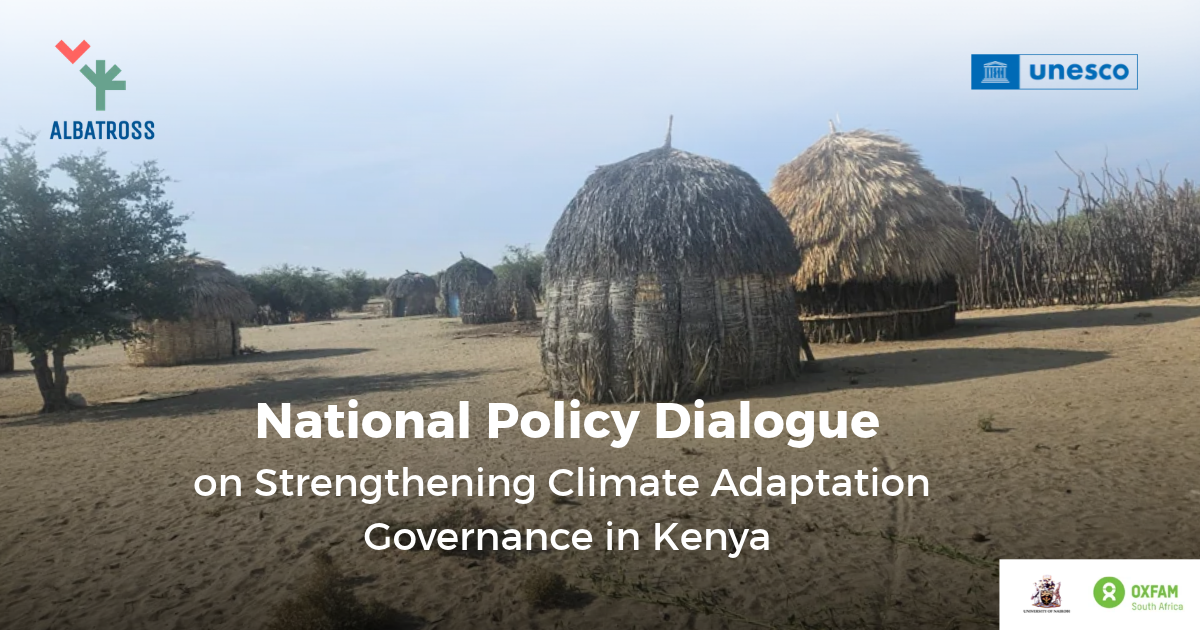
National Policy Dialogue on Strengthening Climate Adaptation Governance in Kenya
Climate change continues to undermine socio-economic development across Sub-Saharan Africa through increasingly frequent droughts, floods, coastal erosion, heat stress and ecosystem degradation. Although African countries contribute minimally to global greenhouse gas emissions, they remain among the world’s most climate-vulnerable economies. Effective adaptation therefore requires coordinated action that transcends sectoral mandates and administrative boundaries while integrating scientific evidence, Indigenous and Local Knowledge, climate services and Nature-based Solutions (NbS).
Kenya’s ecological zones, including arid and semi-arid lands (ASALs), highlands, coastal and urban areas, are experiencing different climate impacts. The ASALs, which comprise most of the country’s land area, experience rising temperatures, prolonged and frequent droughts, and increasing rainfall unpredictability, severely impacting pastoral livelihoods and food security. The highland regions are facing disruptions in the bimodal rainfall system, increasing temperatures, and reducing agricultural yields. The coastal regions are impacted by sea-level rise, coastal erosion, and seawater intrusion.
The EU-funded Advancing Knowledge for Long-term Benefits and Climate Adaptation Through Holistic Climate Services and Nature-based Solutions (ALBATROSS) project has generated a comprehensive evidence base to support these ambitions. Through collaborative research implemented across Ghana, Kenya, Tanzania, Madagascar and South Africa, the project has developed practical knowledge, policy tools and decision-support resources to strengthen climate resilience through integrated climate services and Nature-based Solutions.
As the ALBATROSS project enters the final year, a timely opportunity exists to engage national decision-makers in reflecting on the project’s evidence and identifying strategic actions that can strengthen Kenya’s climate adaptation agenda.
UNESCO, together with national partners, undertook a comprehensive Multilevel Policy Analysis covering environmental and climate policy frameworks at regional, national and sub-national levels. The analysis assessed how existing policies integrate:
- Nature-based Solutions
- Climate Services
- Sustainable Development Goals
- Gender-responsive approaches
- Indigenous and Local Knowledge
- Climate-induced migrations
The assessment identified significant progress while also highlighting opportunities to strengthen policy coherence, institutional coordination, implementation arrangements and financing mechanisms required for effective climate adaptation. The dialogue therefore provides an opportunity not only to validate these findings but also to jointly identify practical policy and institutional actions that can accelerate implementation of Kenya’s climate commitments.
Purpose of the National Policy Dialogue
The National Policy Dialogue will be convened to discuss findings from the analysis of 53 Kenyan policy documents under the ALBATROSS project. The dialogue will bring together Senior government officials, technical experts and county representatives to identify practical ways to incorporate nature-based solutions and climate information services into adaptation planning and policies. The high-level consultation will identify priority actions and proposed institutional leads for strengthening climate adaptation governance in Kenya. A second consultation will take place to get feedback from civil society and community actors on practical ways of applying these actions to improve access to climate information and inclusion of gender and indigenous and local knowledge.
The dialogue, which is envisaged to be continuous, will also explore opportunities for future collaboration between the Government of Kenya and ALBATROSS project partners, including potential technical cooperation under a prospective ALBATROSS Phase II.
Key Expected Outputs from the National Policy Dialogue
- Increased awareness among senior policymakers of the evidence generated through the ALBATROSS project on policy analysis and Guidelines for Adaptation Policy Strategies.
- Recognition of the importance of mainstreaming Nature-based Solutions, climate services, gender-responsive strategies, Indigenous and Local Knowledge, and improved institutional coordination.
- Draft insights on strategic areas for collaboration between Kenya government and ALBATROSS partners under a prospective Phase II project. (e.g climate service EU-AF collaboration, support 2-3 priority policy reviews, CN etc.
Proposed programme
The dialogue will be conducted as a half-day high-level policy consultation comprising:
- Opening Session (Minister, E.U, UNINA, UNESCO-NATCOM, etc)
- Overview of the ALBATROSS Project (UNINA, UNESCO, Oxfam SA,)
- Presentation of Kenya policy analysis key findings -D6.1, D6.3 and D2.3. (UNESCO, UNILI)
- Plenary discussion and stakeholder reflections
- Closing remarks and way forward
Expected Follow-up
The dialogue will contribute to:
- Evidence-informed climate frameworks by ensuring ALBATROSS outcomes are systematically integrated into national climate planning and adaptation priorities. e.g. contribute to ongoing national efforts to review the National Environment Policy 2013
- Institutional coordination through stronger collaboration among government agencies, research organisations, civil society, and development partners to accelerate climate-resilient development.
- Future cooperation by informing technical collaboration with ALBATROSS partners, including climate centers, universities and shaping potential cooperation under a prospective second phase of the project.