
- This event has passed.
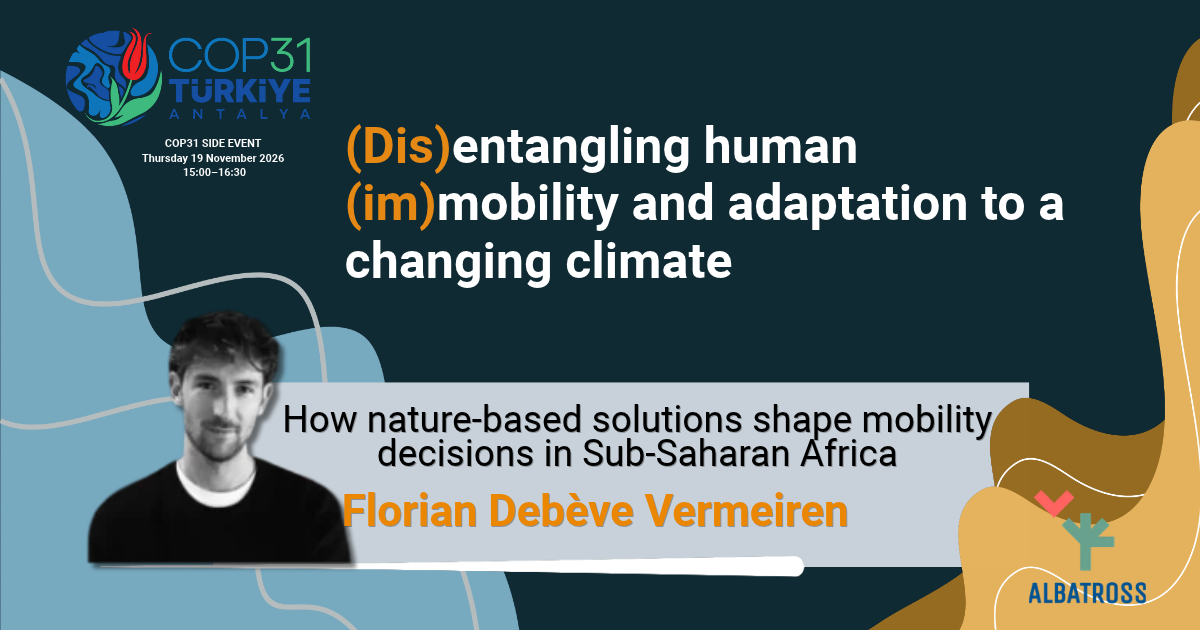
(Dis)entangling human (im)mobility and adaptation to a changing climate
Two blind spots in adaptation policy: how adaptation shapes who moves and who stays, and how mobility shapes who can and cannot adapt.
Adaptation interventions, from nature-based solutions to development finance, reshape people’s aspirations and capabilities to move or to stay. Conversely, migration and translocal livelihoods influence who is able to adapt, and under which conditions. However, key elements of these relationships remain peripheral to adaptation policy. Drawing on evidence from Sub-Saharan and North Africa, Latin America, the Hindu Kush Himalaya and Southeast Asia, this session examines both pathways and their implications for adaptation planning, finance and monitoring.
PATHWAY 1
Adaptation shapes who moves and who stays
Florian Debève Vermeiren, University of Liège, Hugo Observatory – How nature-based solutions shape mobility decisions in Sub-Saharan Africa
Kira Vinke, German Council on Foreign Relations (DGAP) – Habitability under pressure: what shrinking ODA means for climate adaptation and
mobility
PATHWAY 2
Mobility shapes who can adapt
Daniela Paredes Grijalva, University of Vienna – Migrants as agents of climate adaptation: cases from Bolivia, Morocco and
Indonesia
Amina Maharjan, (TBC) ICIMOD – Mobility and adaptation in the mountain communities of the Hindu Kush Himalaya
RESPONDENT
Pablo Escribano, IOM Regional Office in Panama – Migration, Environment and Climate Change Regional Thematic Specialist
Linking both pathways to the ongoing negotiations (GGA, NAPs)