
- This event has passed.
National Policy Dialogue on Strengthening Climate Adaptation Governance in Ghana
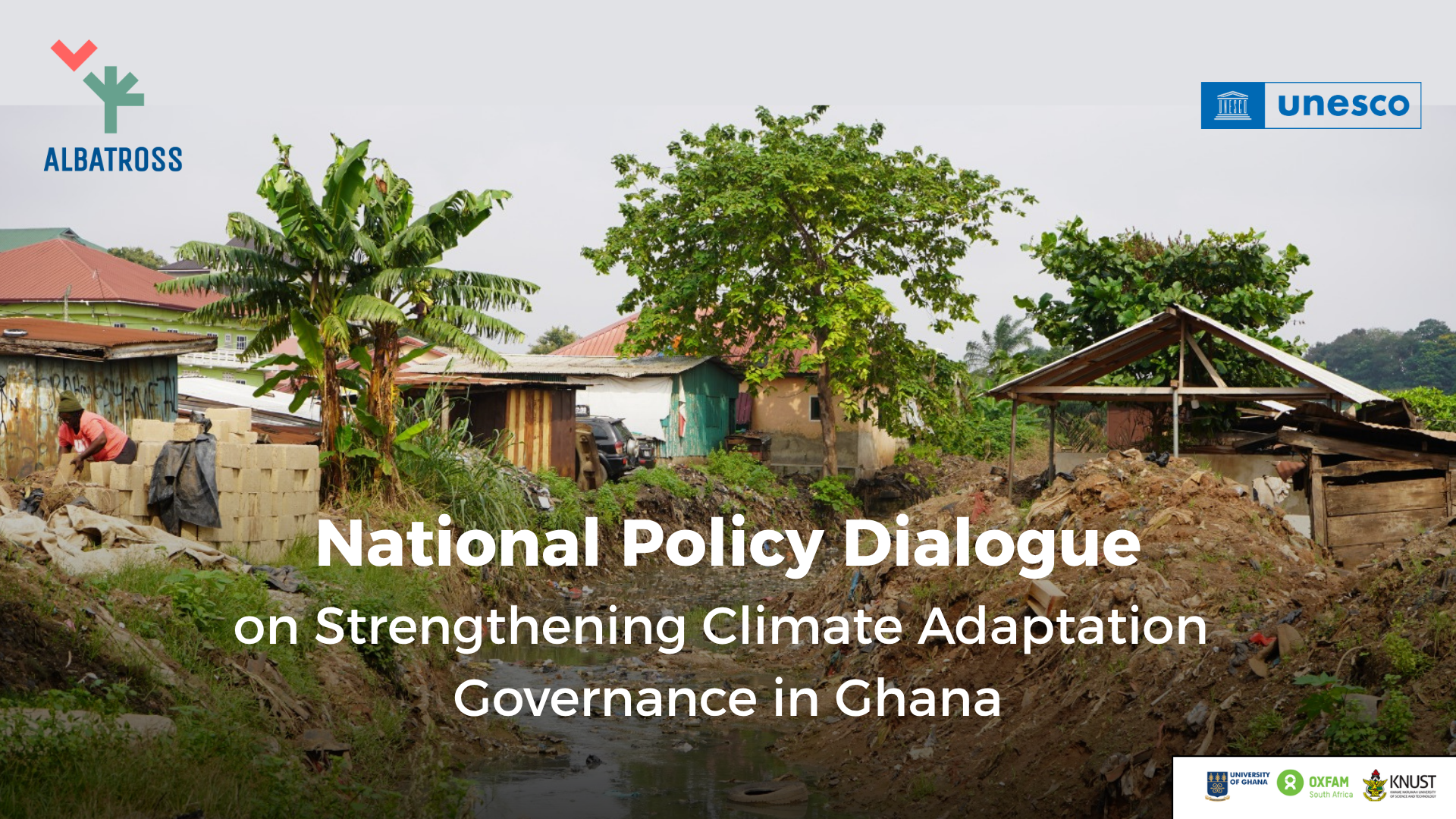
ALBATROSS will be sharing the key findings from the Multilevel Policy Analysis Report and Policy Brief produced in a high-level government policy dialogue. The National Policy Dialogue is jointly organised by the Government of Ghana, UNESCO and the ALBATROSS Project Consortium.
UNESCO, together with national partners, undertook a comprehensive Multilevel Policy Analysis covering environmental and climate policy frameworks at regional, national and sub-national levels. The analysis assessed how existing policies integrate:
- Nature-based Solutions
- Climate Services
- Sustainable Development Goals
- Gender-responsive approaches
- Indigenous and Local Knowledge
- Climate-induced migrations
The assessment identified significant progress while also highlighting opportunities to strengthen policy coherence, institutional coordination, implementation arrangements and financing mechanisms required for effective climate adaptation.
The dialogue therefore provides an opportunity not only to validate these findings but also to jointly identify practical policy and institutional actions that can accelerate implementation of Ghana’s climate commitments.
Purpose of the National Policy Dialogue:
The national policy dialogue provides a high-level platform for policy and decision-makers to review these findings and jointly identify strategic actions for strengthening climate adaptation policy and implementation.
The dialogue will promote evidence-based discussions on improving policy coherence, strengthening institutional collaboration and identifying practical pathways for integrating climate adaptation priorities into national planning and investment processes.
The event will also explore opportunities for future collaboration between the Government of Ghana and ALBATROSS partners, including potential technical cooperation under a prospective ALBATROSS Phase II.
The National Policy Dialogue is being convened under the ALBATROSS Project in collaboration with the Government of Ghana, UNESCO, and the ALBATROSS consortium partners UNIGHA and KNUST, with financial support from the European Union under the Horizon Europe Programme.
Key Expected Outcomes from the National Policy Dialogue
- Increased awareness among senior policymakers of the evidence generated through the ALBATROSS project on policy analysis and Guidelines for Adaptation Policy Strategies.
- Recognition of the importance of mainstreaming Nature-based Solutions, climate services, gender-responsive strategies, Indigenous and Local Knowledge, and improved institutional coordination into national development agendas.
- Draft insights on strategic areas for collaboration between the Government of Ghana and ALBATROSS partners under a prospective Phase II project. (e.g, climate service EU-AF collaboration, support 2-3 priority policy reviews, CN etc.)
Proposed Next Steps:
- Evidence-informed climate frameworks by ensuring ALBATROSS outcomes are systematically integrated into national climate planning and adaptation priorities. e.g contribute to ongoing national efforts to operationalise the National Adaptation Plan 2025
- Institutional coordination through stronger collaboration among government agencies, research organisations, civil society, and development partners to accelerate climate-resilient development.
- Future cooperation by informing technical collaboration with ALBATROSS partners, including climate centres, and shaping potential cooperation under a prospective second phase of the project.
Proposed programme:
The dialogue will be conducted as a half-day high-level policy consultation comprising:
- Opening Session (Ministers, E.U, UNESCO-NATCOM, UNIGHA, KNUST etc)
- Overview of the ALBATROSS Project (UNIGHA, KNUST, Oxfam SA,)
- Presentation of Ghana policy analysis key findings -D6.1, D6.3 and D2.3. (UNESCO, UNILI)
- Plenary discussion and stakeholder reflections
- Closing remarks and way forward
Expected Follow-up
- Evidence-informed climate frameworks by ensuring ALBATROSS outcomes are systematically integrated into national climate planning and adaptation priorities. e.g contribute to ongoing national efforts to operationalise the National Adaptation Plan 2025
- Institutional coordination through stronger collaboration among government agencies, research organisations, civil society, and development partners to accelerate climate-resilient development.
- Future cooperation by informing technical collaboration with ALBATROSS partners, including climate centres, and shaping potential cooperation under a prospective second phase of the project